
The approach to maintenance and equipment reliability must be considered in full view of the papermaking business with all parties and departments aware of the targets and goals of the individual mills and business units.
In short each department, and in most cases this refers to the daily interface between Production and Maintenance must be aware of the points of focus.
The concept of reliability and current best practices is easy to describe and discuss – the more difficult part is determining your path towards reliability and maintenance and more importantly, sustaining standards and developing a continuous improvement culture.
However, being armed with the best techniques, procedures and systems does not mean that you will enjoy a trouble free life with the best reliability figures on the planet – Ian Farrell, UPM-Kymmene, UK
“Process and Equipment Reliability”
Above all, a Production plan must exist in response to the market demand. The maintenance effort must then be built around the production plan to support the business. The risks involved in the delivery of the production plan from the point of view of each department much remain in full focus of all concerned.
The impact of our short and long term decisions is seen in how the business functions and the many cases of balance of the ‘risk’ component is different if you work in Operations or Maintenance.
The ‘risk’ of running equipment beyond repair intervals is clear to maintenance personnel – the ‘risk’ of not meeting the market or not achieving production targets is clear to operations personnel.
The management of this ‘risk’ can be made easier if the ‘right things’ are done to support the business.
This paper will outline the work carried out by the Caledonian and Shotton mills during a CBP audit to identify where they ranked beside Current Best Practice – information the mills will now use to develop their maintenance departments in the continued support for the papermaking business within UPM-Kymmene.
UPM-Kymmene – Caledonian
Caledonian Paper is the UK’s only manufacture of LWC. The annual production capability is in excess of 250,000 tonnes. The mill services the local markets as well as exporting to Europe, the USA and to Asia.The mill is situated on the South West of Scotland some 35 miles from Glasgow.
UPM-Kymmene – Shotton
Shotton Paper is the largest newsprint manufacturer in the UK. The output is around some 470,000 tonnes which in turn supplies 20% of the daily needs of the entire UK newspaper industry.
Shotton Paper recycles around 350,000 tonnes of old newspapers and magazines. The mill is situated in North Wales only a few miles from the city of Chester.
CURRENT BEST PRACTICE AUDITS
The maintenance management of the Caledonian and Shotton mills had a desire to benchmark their actual equipment reliability and draw comparison against the Current Best Practice.
The goals of the exercise being:
- To increase the awareness of the organization in the area of Best Practice.
- To build a positively challenging relationship across the maintenance departments of Shotton and Caledonian.
- Create a learning opportunity for the development and education of maintenance people.
- To identify the most important improvement opportunities and encourage the most appropriate actions.
- To create an atmosphere where people will readily share experiences and information.
- Maximize effectiveness of our people.
Traditional maintenance audits may center around functions which do not offer a chance to improve on the effectiveness of maintenance. These may be driven around a review of the budget, or the establishment of meetings and brainstorming sessions.
It is fundamentally obvious that unless an organization is prepared to expose itself to a system where feedback can be given on all maintenance related issues then the opportunity to create improvement may be minimized or lost.
The opportunity to audit out maintenance performance in line with world class comparisons gave Caledonian and Shotton a first class opportunity to develop.
The benefit of having internally trained personnel facilitated by IDCON was viewed as a further opportunity for the development of our maintenance practices.
We realized through our communication that an opportunity was there to have a look at how each mill shaped up to the World Class utilizing a Best Practice Audit.
THE CBP PROCESS
- Audit team training. This team training took two days and was facilitated by Christer Idhammar.
- Input data from plant.
- CBP seminar triggers start.
- CBP seminar gives initial direction.
- Audit team interviews 50 people using 270 prepared CBP questions. This process took one week in each mill.
- All 270 questions scored against a known world class benchmark figure.
- Scores evaluated.
- Scores agreed.
- Strengths are indicated.
- Improvements and developed.
- Presentation of results to initial seminar audience took place at the end of the week long audit.
THE INPUT DATA
The audit commenced by each team selecting their audit team. In our case we selected four maintenance people from each mill. The individuals were trained in maintenance auditing by IDCON.
In its simplest form, the CBP exercise looks at ‘what is’ versus ‘what could be’.
The audit process being as follows:
Mills Select Teams
Caledonian and Shotton selected teams comprising four persons. A multi-disciplined approach was obtained from both mills.
Detailed Questionnaire:
A questionnaire was requested to enable the audit requirements to be set and the commencement of a benchmark against other known elements.
The questions being:
- How is the mill divided by production area?
- What product types are manufactured.
- A total breakdown of all maintenance staff functions.
- A total breakdown of all operations staff functions.
- Other staffing levels.
- Hourly rates.
- Identification of mill bottlenecks.
- Production data.
- Maintenance productivity.
- Maintenance costs.
- Manufacturing cost.
- Safety record.
- Training programmers.
- Run maintenance categorization.
- Breakdown of Predictive maintenance staff.
- List of Condition Monitoring tools.
- Maintenance prevention resource and techniques.
- Maintenance shift staffing and workshop organization.
- CMMS system set up and utilization.
- Materials management system.
- Planning and scheduling performance.
From the questionnaire three further areas were developed.
PREVENTIVE MAINTENANCE
- Mechanical inspection routes.
- Grease routes.
- Oil sampling reports.
- Balancing standard.
- Alignment standard.
- Lubrication standard.
- Equipment criticality analysis.
PLANNING AND SCHEDULING
- Planning and scheduling manual.
- Work order flow process.
- Planned task documentation.
- Scheduled task documentation.
- Backlog statistics.
- Shutdown evaluation.
ROOT CAUSE PROBLEM ELIMINATION
- Documented solutions to problems.
A comprehensive summary can be built up of the key maintenance data along with Operations and safety statistics.
THE AUDIT TRAINING
From the summary documentation it is possible to build up a fairly accurate picture of how things are in the participating mills – also it starts to awaken a feeling that the maintenance practices are not all that they could or should be.
A picture starts to be formed in the minds of the audit teams that the exercise that they are about to take part in will not only be informative but extremely useful for the ongoing development of the mill maintenance system and practices.
The audit training was aimed at giving the team members the confidence to be able to conduct an audit in an effective professional manner.
The training of the audit teams was carried out at the Shotton mill over a two day period. It was carried out by Christer Idhammar.
The “Training Mission”
- Was to educate and unify the audit teams in both the approach and definition.
- The planning and scheduling process linked specifically to the audit programmer.
- To assign the individual notes of the team.
The approach of Christer when training the teams was a key factor. Christer spent a lot of time positioning the importance of the project and explaining its potential benefits, if carried out properly.
The training language was simple and a systematic path was followed through the business needs and how maintenance can have a major impact on the results of a business.
This was then developed to the items and functions which were to be audited and exploring the pre-prepared documentation to ensure that everyone fully understood the task ahead and the importance of their part.
The teams became familiar with the questionnaires and methods to be undertaken in the audit.
The initial questionnaire concentrated on front line maintenance and the impact of the individuals connected with the maintenance effort.
THE SEMINAR
It called for the auditor to ask questions and rank each answer from 1 (poor) through to 10 (excellent), eg. How well do we:
- Do detailed cleaning?
- Do lubrication?
- Do fixed time maintenance?
- Do condition monitoring?
- Avoid emotional break-in work?
After the general questions some more detail was required around the Planning and Scheduling of Daily and Shutdown work.
This was to measure the effectiveness around the maintenance effort from Break-in through to Planned and Scheduled.
The final stage of this aspect brought together the questions around Preventative Maintenance and Planning and Scheduling, e.g.
- Backlog management ? we know the trend
- Job status ? we know the status
- Spare parts ? we can find easily
- Spare parts ? are always available
- Problems ? we analyze and find root cause
- Operations and Maintenance ? we have a close partnership
- Training ? we have a training plan
The survey results would be presented at the end of the week long audit along with all other data.
The audit team found themselves taking on different roles, documenters, presenter and information processor. The process can be summarized.
AUDIT DETAIL
The 270 questions are detailed. Current Best Practice elements of world class maintenance.
When examined there is not one single item which does not have a relevance to a maintainer. The elements not only proved relevant to the Caledonian and Shotton Mills but started the teams on an educational journey – a voyage which would challenge and develop their ways of thinking about maintenance.
The interviews were broken down in 10 categories,
- Preventive Maintenance
- Planning and Scheduling
- Root Cause Problem Elimination
- Technical Database
- Materials Management
- Leadership
- Safety
- Skills
- Equipment Condition
- Engineering
The 10 categories or maintenance processes can be broken down via sub-processes to the elements which are the lowest level of detail in a key process.
KEY PROCESS – These processes which are key to the discipline of maintenance and can be used to support the papermaking business.
SUB PROCESS – Lower in the hierarchy then a process but when grouped with several sub processes becomes a process.
ELEMENTS – A CBP is equal to an element, which is the lowest level of detail in a key process. It is the best way to do something.
- KEY PROCESS – Planning and Scheduling
- SUB PROCESS – Work Request
- ELEMENTS – Scope, Definition, Priority, Documentation
The elements are put together as questions. The questions then take the auditors through the Key Process areas.
Example:
SUB PROCESS – Planning and Scheduling
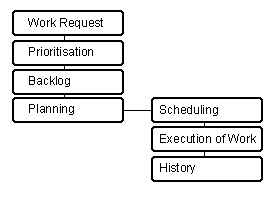
The data to the Element questions being gathered and scored is then put together and averaged against each of the Sub Process areas under the Key Process.
The Sub Process areas when viewed as a graph or bar chart can be tracked against CBP. A score of 85 is rated as world class. The Caledonian and Shotton mills fell short of world class which was a prediction made by the host teams in each case.
RESULTS
The results were obtained by giving each ELEMENT a score, when compiled we have a score for each SUB PROCESS. The scores for the SUB PROCESSES are then added together and when averaged we have the overall KEY PROCESS SCORE.
The education of the audit teams really starts to develop at this stage – the awareness of their own mills shortcomings is instantly apparent. The comments start to come through.
“We say we do this, but we never do!”
“We have a maintenance management system which could be used to greater effect”.
“Why don’t we have documented standards”.
“We are good at maintenance but we could be much better”.
“If everyone in my organization knew our direction then we could improve rapidly”.
The first aspect in the maintenance education is to find out where you are – ie. The starting point and when the information is available to develop world class targets then it is easy to define the area where everyone would like to get to.
The method used to audit and obtain results focused on the evaluation and measurement of key equipment reliability and the maintenance processes.
- How are processes documented.
- How are processes executed.
- How are processes tracked.
The simplification of the process for data gathering and analysis develops the learning experience and broadens the educational horizon.
Caledonian and Shotton when compared to other similar mills (not named) came out ahead in the overall stakes.
This we felt was good for our mills and indicated the sense of great pride to be part of the UPM-Kymmene network of sites – this pride developed through the strong relationships and information sharing already in existence globally.
KEY PROCESS SCORES
As stated previously the key process scores for both sites fell short of world class, not significantly, however we placed an expectation on each mill to use the audit as a means to improve. There were similarities and stark differences in the final results. This had a positive effect on the audit teams.
- When a good score was achieved they could draw from the learning how that score came about.
- When a poor score was achieved a positive determination to create improvement now exists.
- Each mill now had the support of the other.
- Learning is also possible via the UPM-Kymmene group.
From the key process scores, the top three improvement areas were identified for each mill. Some progress has been made in these areas to date.
Shotton – Key Improvement Areas
Leadership & Organization–This improvement need was based on the following:
- Requirement for a written and communicated long-term maintenance strategy.
- Key Performance Indicators which are clearly associated with the business should be followed and developed as an improvement trend.
- Communication of targets and feedback of the performance should be improved.
- PM / ECCM (Preventive Maintenance / Essential Core and Condition Monitoring
The lack of maintenance standards: - Written guidelines clearly outlining procedures eg. Lubrication practices, balancing, bearing fitting filtration, alignment etc.
- Action plans to resolve number of oil leaks.
- Skills Development
- Identification of core skills required for each job.
- Skills matrix being used to identify areas lacking.
- Develop training programmer.
- Root Cause Problem Elimination
- Implementation of a standard process to document problems and identify solutions
Caledonian – Key Improvement Areas
Leadership & Organization
With some KPI’s in place and some CBP’s Caledonian still fell short in this area.
- Establish future plant wide direction for maintenance CBPs and KPIs (3 year plan).
- Set goals for timing an track the organizations progress against goals.
- Establish detailed plans which include for example “standards regarding balancing, alignment, equipment cleaning, backlogs, priorities, and recording of history.
Planning & Scheduling
Continue bringing Planning and Scheduling up to world class.
- A work prioritization system should be scoped and agreed.
- Backlog management should be defined.
- Scheduling of tasks for each trades person should be improved and have a more systematic approach.
- Standard job plans are required for all key tasks.
RCPE (Root Cause Problem Elimination)
- Initiate a standardized site wide RCPE program for all failures using standardized (5 whys) methodology.
- Integrate this program with the rest of the maintenance systems.
- Use RCPE as a trigger to select cost effective maintenance methods such as FTM, CBM, etc. when problems cannot be eliminated.
CONCLUSIONS
- The audit gave Caledonian and Shotton a unique opportunity to view each other in a ‘no holds barred’ situation.
- The mills are now committed to making improvements in every direction.
- The mills are now committed to working together.
- The audit gave the individuals involved an educational experience second to none. They were able to view 2 organizations from the ‘inside’, an opportunity which can only present itself in this structured manner as set out by IDCON.
- It is now up to the maintenance management of each mill to develop their entire maintenance strategy in support of the papermaking business.
- Inside UPM-Kymmene there are around 53 paper machines. We have only touched on maintenance benchmarking in the past. An opportunity exists within UPM-Kymmene that we use a tailor made organized benchmark framework to carry out benchmark audits and reviews in a planned ongoing basis.
REFERENCES
IDCON CBP Audit Caledonian and Shotton – July 2001
CBP at Shotton – Antti Wiksten, Maintenance Manager, Shotton
CBP Audits – a view – Hal McCoy, HR Development Manager, Shotton