

We are taught that dirt is bad for bearings. But why is it bad?
If dirt enters between the ball/ roller and the bearing race, the oil film breaks and dirt will grind between the roller elements and the bearing race. But isn’t it a bit much to ask craftspeople to wear gloves, work in clean rooms, and cover open bearing with plastic bags while working on the bearing installation?
To answer the question, we need to know two things. First, how big is the clearance between the roller element in the bearing and the bearing race?
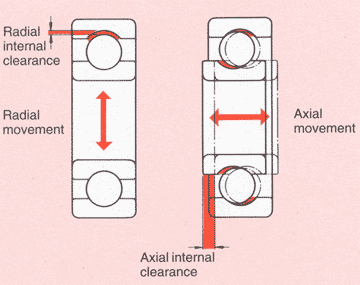
We can call the clearance internal radial play and internal axial play. See figure 1, illustrating bearing radial and axial play.
Second, how big are the dirt particles that may get inside the clearances?
Let’s start with the clearances inside bearings.
The internal clearances (play) in bearings before they are mounted can, for example, be found in a SKF catalogue, the clearances vary from 0 to 1,000 micrometers (micrometer = one millionth of a meter), depending on size and type of the bearing.
However, the clearance for mounted bearings is what is really interesting. The clearance number can’t be found in catalogues because the internal clearance will depend on temperature, mounting method, tolerances on shafts etc.
But, by discussing the subject with Pall filtration, we found that most roller bearings used in industry have an internal radial clearance of 1-5 microns. It’s a wide range, but it gives us a ball park number to work with.
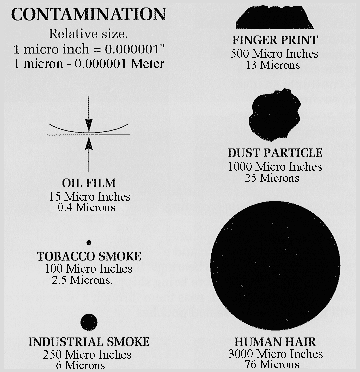
Let’s compare clearance range (1-5 microns) with some of the common dirt size in industry. Figure 2 helps us visualize the size of common contamination factors together with some figures for size reference.
Conclusion. We can clearly see that common contamination such as dust, tobacco smoke and finger prints can damage most bearings since the clearances in bearings are the same size or smaller than common contamination.
Therefore we can conclude that clean rooms, gloves and usage of covers for bearings are very important for bearing reliability.