

This column is likely to create a lot of reactions from the academia of reliability and maintenance management, and all comments are welcome.
Using Reliability-Centered Maintenance Wisely
Reliability-Centered Maintenance (RCM) has its place, but many times plants jump into training programs and attempt to implement Reliability Centered Maintenance long before they are ready for it.
The academia of maintenance management still argue about its definition. Some even say that if it is not done exactly the way they prescribe, then it is not RCM. So what? The whole idea is that you want to achieve more cost-effective reliability through the implementation of better operations and maintenance practices.
The RCM method has its definite place in the specification and design phase of new equipment and systems, and for existing critical and complicated systems.
The thought process used, for example, to analyze existing preventive programs, is good, but can easily be made overcomplicated to serve the purpose. I have analyzed the results of many RCM implementations, and the fact is that after a very lengthy criticality and failure mode analysis, the end results have not changed the fact that a V-belt drive needs to be inspected for an obviously critical belt conveyor!
What is often missing is a document describing how to inspect it while the equipment is operating. In the worst cases, belts, couplings, heat exchangers, control valves, and other common components are, even after the RCM analyses, inspected during shutdowns.
Perhaps some inspections have been deleted because equipment was not critical. So, there you might have saved an inspection that only takes two minutes for an operator who will inspect the process in that area every shift anyway!
I suggest that before you implement a RCM program you do the following:
- Do your maintenance prevention well;
- Do your basic inspections well;
- Do your predictive maintenance well.
The first two of the above activities are low cost and easy to implement because of high acceptance by people in your organization.
You can use standard training material to train people when and how to do inspections. IDCON’s Condition Monitoring Standards is a good resource for this.
What you do with, for example, a coupling, can be decided without a complicated analysis.
The failure developing period for misalignment might be two to eight weeks, so you need to inspect it every week on the run using an infrared thermometer.
How to do this is described in a Condition Monitoring Standard for each common component. Download an example of our Condition Monitoring Standards.
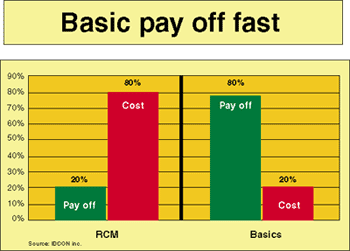
KNOWING THE BASICS
The time to implement is short; a production area can have all inspections documented, people trained, and inspections executed in less than four weeks.
An reliabilty centered maintenance approach and implementation could take six months with no different result.
An RCM analysis might lead you to spend days deciding that the primary screen is critical, and that if the bearings fail the screen goes down; therefore, you need to inspect the bearings—all of which is obvious.
Note it also does not consider planning and scheduling and people efficiency at all, nor does it include vital support systems such as a technical database and its interface with stores.
RCM is therefore a tool that should be used selectively for critical and very complicated systems and equipment. It is not a complete reliability and maintenance system.
Do not fall into the trap of believing it is something completely new and different, or that it is a complete program for reliability and maintenance.
I know organizations that have spent over three years on RCM implementation and they still do not have the basics in place and/or executed well. It cannot be reinforced often enough to do the basics well before you start complicating things.
Do you need help determining your next step with RCM? Give us a call or send us an email at info@idcon.com.
We’d love to help.